Tamper evident RFID labels are specialized RFID tags designed to show evidence of unauthorized removal, opening, or transfer while providing electronic identification through radio frequency technology. Unlike standard RFID stickers, these labels use fragile materials, destructive adhesives, breakable antenna structures, or special transfer processes to make intact removal and reuse difficult.
When someone attempts to remove a properly applied tamper evident RFID label, the label may tear, leave visible damage, or lose its RFID communication function. Depending on the design, the tampering can be detected through visual inspection or an RFID reader.
Businesses use tamper evident RFID labels to protect product identification, improve asset traceability, support warranty management, and reduce the risk of unauthorized label transfer. They are particularly useful when a physical product or asset needs to remain linked to one unique electronic identity throughout its service life or distribution process.
For example, an electronics manufacturer can apply a fragile RFID label across an equipment enclosure. If someone attempts to remove the label to transfer it to another device, the fragile structure is designed to tear and the antenna may break, preventing normal RFID communication.
Meihe RFID provides several anti-tamper solutions, including fully fragile RFID labels, breakable antenna RFID labels, HF/NFC labels, and UHF RFID fragile tags. Different structures can be selected according to the required level of tamper evidence, reading method, and application environment.
Businesses looking for these solutions can visit the Tamper-Evident RFID Labels product category to compare available designs and customization options.
How Do Tamper Evident RFID Labels Work?
The working principle combines physical tamper detection with RFID electronic identification. A standard RFID label is designed to remain readable after application. A tamper evident RFID label, however, is manufactured with a structure that reacts when someone tries to peel it away or transfer it to another surface.
Different products use different methods to create this effect. The most common approaches include fragile face materials, antenna break structures, adhesive transfer, and layered security constructions.
Fragile material destruction
Some RFID labels use fragile paper or specially designed face materials. When removal is attempted, the material tears into pieces rather than separating cleanly from the surface. In fully fragile RFID labels, the antenna is integrated with the fragile structure so that it is designed to break during removal.
Breakable antenna technology
Another method uses a deliberately designed weak point in the RFID antenna circuit. During removal, mechanical stress breaks the conductive connection. The RFID chip may remain physically intact, but the damaged antenna prevents normal communication with the reader.
Adhesive transfer and visible tamper evidence
Some labels are manufactured with special adhesive layers that leave residue, transfer part of the label to the mounting surface, or reveal a VOID or OPEN pattern when removed. These designs allow staff to identify possible interference through visual inspection.
Combined physical and electronic protection
For applications requiring stronger control, manufacturers can combine fragile materials, permanent adhesive, and antenna destruction in one RFID label. This provides both visible evidence and electronic functionality loss after removal.
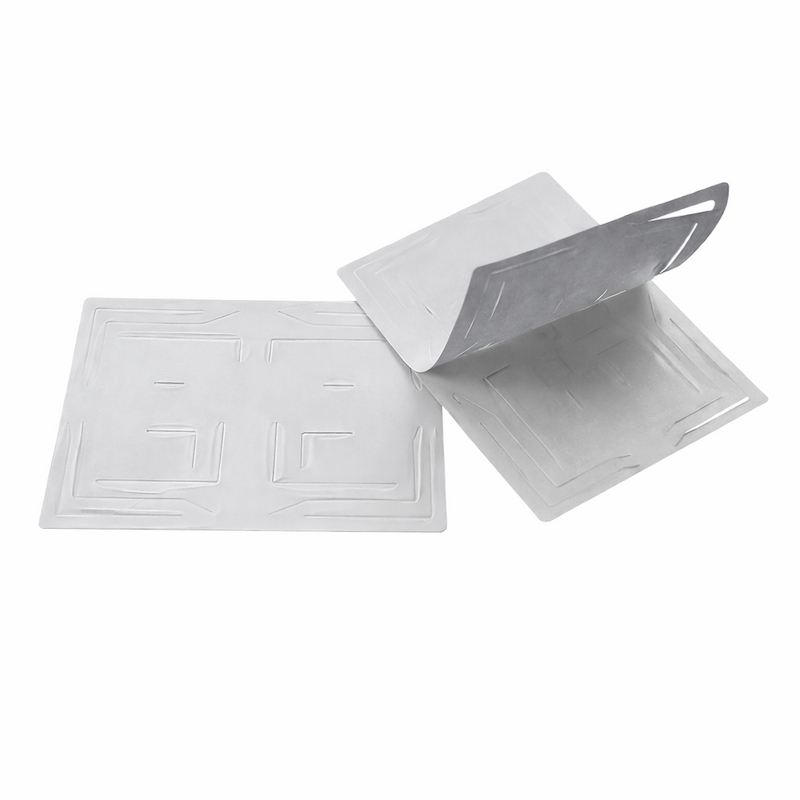
Fragile RFID label construction designed to show physical damage during removal.
It is important to understand that not every tamper evident RFID label works in exactly the same way. Some products are designed to leave a visible mark, while others are engineered to disable the RFID circuit. The appropriate design depends on whether a business needs visual inspection, electronic tamper detection, or both.
Different Types of Tamper Evident RFID Labels
Choosing the correct RFID security label starts with understanding how each construction responds to unauthorized removal. A label that works well for product packaging may not be suitable for industrial equipment or long-term asset management.
Fully Fragile RFID Labels
Fully fragile RFID labels are designed to remain attached to the original product or asset. Their antenna is transferred onto a fragile face material. When the label is correctly applied and someone attempts to peel it off, the material tears and the antenna is designed to break with it.
This structure makes intact removal and secondary transfer much more difficult than with conventional RFID stickers. HF NFC and UHF versions can be selected for different identification and tracking requirements.
Meihe's Custom Fully Fragile RFID Labels for Tamper Evident Identification support customized dimensions, printing, encoding, serial numbers, barcodes, and variable data. They are suitable for equipment warranty seals, IT assets, product packaging, and one-time asset identification.
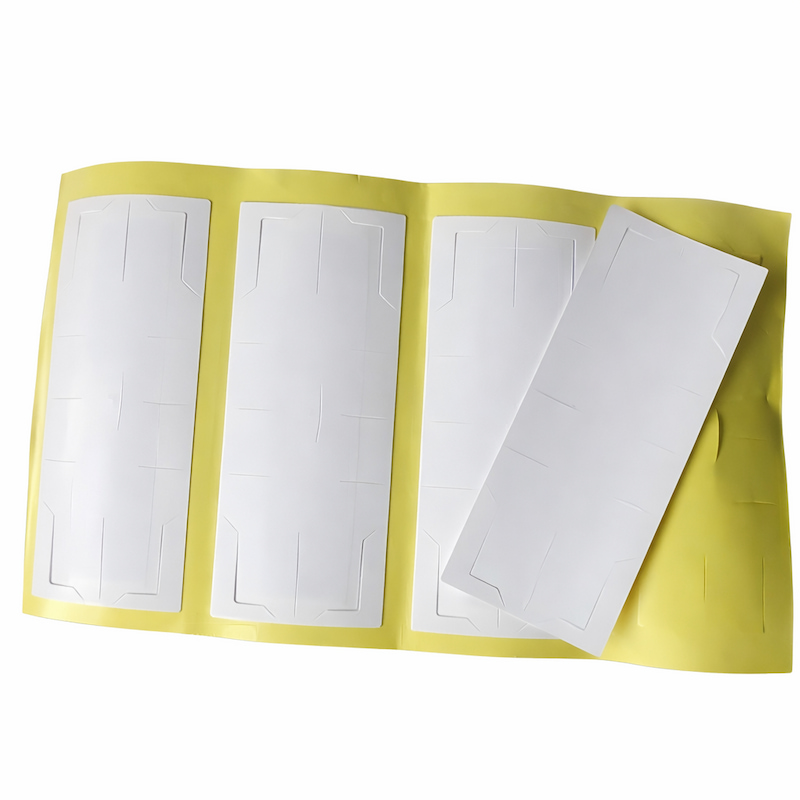
Fully fragile RFID labels supplied on backing material for customized applications.
Breakable Antenna RFID Labels
Breakable antenna RFID labels use a controlled weak point within the antenna circuit. When removal force is applied, the conductive connection is designed to fracture, making the tag unreadable under normal operating conditions.
This design is particularly useful when a business needs the RFID identity to become invalid after the label leaves its original mounting position.
For example, an IT department can attach an antenna-break RFID label to a computer or communication device. If the label is removed, the antenna structure can be damaged, preventing the credential from being transferred and reused as a normal readable tag.
Meihe offers Tamper-Proof Fragile RFID Labels with Breakable Antenna, with NTAG213 or customized chip options, coated paper or PET materials, and permanent adhesive options for suitable applications.
RFID Fragile Security Labels
RFID fragile security labels use destructible label materials to provide one-time identification and visible tamper evidence. They can be selected for access control, asset tracking, secure packaging, and brand protection projects.
Depending on the selected version, these products can support HF or UHF RFID technology. Printing and electronic identification can be combined to help businesses connect a physical product with its corresponding identification data.
For projects involving inventory control, logistics, and secure identification, Meihe's RFID Fragile Tag Tamper Evident Security Label provides an additional option with customized printing and chip configurations.
Anti-Tamper NFC Labels with Secure Authentication Chips
Some product authentication projects require more than simple RFID identification. NFC labels with secure authentication chips can support electronic verification when connected to a suitable verification platform.
For example, NTAG424 DNA-based solutions can support cryptographic authentication features. When combined with an appropriate server-side verification process and an anti-transfer label structure, they can help brands strengthen product authentication and reduce unauthorized label reuse.
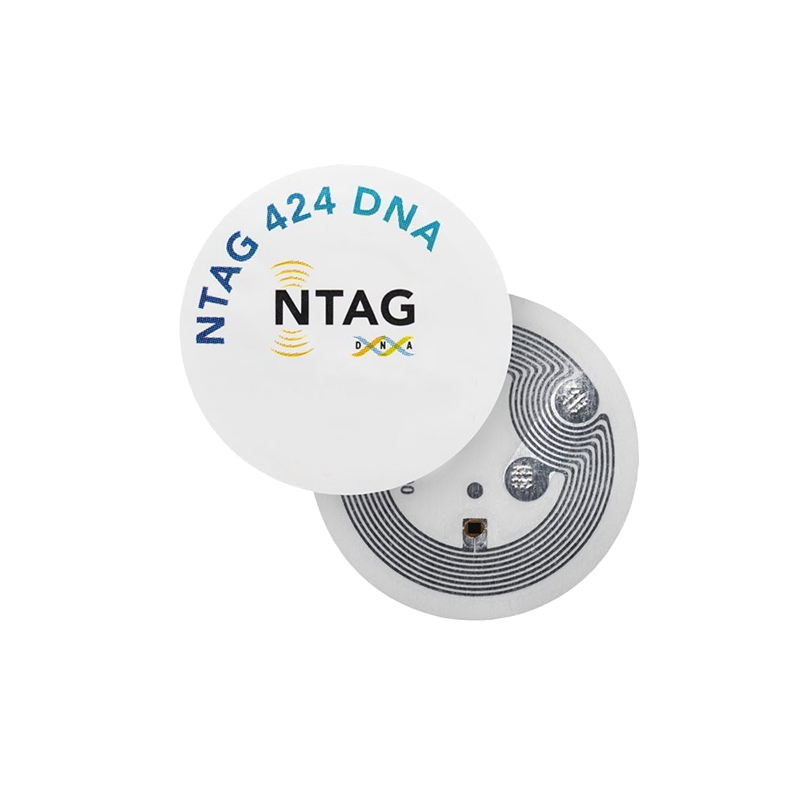
NTAG424 DNA NFC label components for secure product identification applications.
A standard RFID chip does not automatically provide product authentication. Businesses should confirm the chip's security features, authentication method, and backend verification requirements before selecting a solution.
Tamper Evident RFID Labels vs Standard RFID Stickers
One common mistake in RFID purchasing is assuming that all RFID stickers provide the same level of protection against unauthorized removal. In fact, standard RFID labels and tamper evident RFID labels are designed for different purposes.
Standard RFID stickers usually prioritize stable reading performance, easy application, and long-term identification. Tamper evident versions prioritize removal detection and resistance to unauthorized transfer.
| Comparison Factor |
Standard RFID Sticker |
Tamper Evident RFID Label |
| Main Purpose |
Identification and tracking. |
Identification with removal evidence. |
| Removal Behavior |
May be removable intact depending on adhesive and surface. |
Designed to tear, transfer, or lose functionality when removed. |
| Antenna Structure |
Designed for normal RFID communication. |
May include a breakable antenna or fragile transfer structure. |
| Reusability |
May remain reusable after removal. |
Designed to discourage intact removal and reuse. |
| Tamper Detection |
Usually requires separate monitoring methods. |
Can provide physical evidence or electronic failure. |
| Typical Applications |
Inventory, logistics, and general identification. |
Warranty protection, asset security, product packaging, and anti-transfer control. |
The right choice depends on the risk involved. If a label only needs to identify an item during warehouse scanning, a standard RFID sticker may be sufficient. If the label must remain permanently associated with a specific asset or product, a tamper evident RFID solution is more appropriate.
Why Do Businesses Need Tamper Evident RFID Labels?
Businesses need tamper evident RFID labels when product identity, warranty status, asset ownership, or supply chain records must remain linked to the original physical item. A conventional label can identify a product, but it may not provide reliable evidence when someone attempts to remove or transfer it.
Here are several practical reasons why companies choose tamper evident RFID technology.
Protecting product authenticity
For manufacturers and brand owners, unauthorized product substitution and label transfer can create serious problems. Tamper evident RFID labels make it harder to move a legitimate electronic identity from one product to another without leaving evidence of interference.
When combined with unique identification numbers, QR codes, secure chips, and an authentication platform, these labels can strengthen product verification processes.
Supporting warranty and after-sales management
Electronics manufacturers, equipment suppliers, and service providers can apply fragile RFID labels across product enclosures or selected access points. If an unauthorized removal attempt damages the label, the service team has an additional indication that the equipment may have been opened or altered.
This can help with warranty inspections and maintenance records. However, warranty decisions should still consider the actual product condition and applicable service policies.
Improving asset management
IT equipment, communication devices, tools, and rental assets often move between departments, facilities, and users. A tamper evident RFID label can help maintain the relationship between each physical asset and its electronic identity.
When integrated with an asset management system, organizations can use RFID identification to support inventory checks, asset registration, service records, and exception handling.
Reducing unauthorized transfer in logistics
During transportation and distribution, products may pass through multiple handling points. Anti-transfer RFID labels can help businesses detect potential interference when the label is removed or damaged before the shipment reaches its destination.
For applications involving container security, RFID electronic seals can provide a different solution by recording seal identification and helping monitor whether a secured transport unit has been physically opened.
Supporting pharmaceutical and high-value product protection
Pharmaceutical products, cosmetics, luxury goods, premium beverages, and other high-value products may require additional packaging identification and anti-tamper measures. NFC-based security labels can provide product information and support digital verification when connected to a suitable authentication service.
For these industries, the label should be selected according to the product packaging material, environmental conditions, required authentication method, and applicable regulatory requirements.
Which Industries Use Tamper Evident RFID Labels?
Tamper evident RFID technology is useful across industries where businesses need to identify products while detecting unauthorized removal or transfer.
| Industry |
Typical Application |
Recommended Consideration |
| Electronics |
Warranty seals and device identification. |
Fragile labels or antenna-break structures. |
| Pharmaceuticals |
Packaging identification and product verification. |
Secure NFC chips and suitable packaging adhesives. |
| Logistics |
Shipment identification and asset tracking. |
UHF RFID and anti-transfer construction. |
| IT and Data Centers |
Computer, server, and equipment identification. |
Compact fragile labels and unique data encoding. |
| Luxury Goods |
Brand protection and product authentication. |
NFC authentication and customized security printing. |
| Medical Equipment |
Equipment identification and maintenance control. |
Suitable materials, adhesives, and environmental resistance. |
| Automotive |
Component identification and vehicle-related verification. |
Surface compatibility and temperature resistance. |
For companies managing multiple product lines, the same tamper evident RFID concept can be adapted to different physical formats, chip technologies, label dimensions, and data requirements.
HF NFC vs UHF: How to Choose the Right RFID Technology
Frequency selection is one of the most important technical decisions when purchasing tamper evident RFID labels. HF NFC and UHF are designed for different reading environments, so the right choice depends on how the labels will be scanned and what equipment the business already uses.
HF NFC RFID labels operate at 13.56 MHz. They are suitable for close-range identification, smartphone interaction, product information access, and applications using compatible HF readers.
UHF RFID labels typically operate between 860 and 960 MHz. They are commonly used for inventory management, logistics, warehouse operations, and applications requiring longer reading distances or multiple-tag scanning.
| Technical Factor |
HF NFC |
UHF RFID |
| Frequency |
13.56 MHz |
860–960 MHz |
| Typical Reading Method |
Close-range reader or compatible smartphone. |
Dedicated UHF RFID reader and antenna. |
| Typical Applications |
Product authentication, service seals, and NFC identification. |
Logistics, warehouse inventory, and asset tracking. |
| Chip Examples |
NTAG213, NTAG424 DNA, MIFARE, and other compatible HF chips. |
Impinj and other EPC Gen2-compatible UHF chip options. |
| Selection Priority |
Smartphone compatibility and authentication requirements. |
Reader compatibility, antenna design, and required reading range. |
Neither frequency is automatically more secure than the other. Security depends on the chip features, communication protocol, authentication process, system configuration, and physical anti-tamper structure.
It is also important to consider the mounting surface. Metal can interfere with standard RFID antenna performance, and some liquid-rich or electrically conductive environments may affect reading reliability. If the label will be attached to metal equipment or special packaging, the antenna design and surface compatibility should be tested before mass production.
How to Choose the Right Tamper Evident RFID Label
A suitable RFID label should match the product's physical structure, security requirements, operating environment, and RFID system. Choosing a label based only on its appearance or advertised chip type may lead to poor adhesion, inconsistent reading performance, or insufficient tamper evidence.
Before requesting a quotation, businesses should evaluate the following factors.
Label material and physical construction
Determine whether the application needs fragile paper, coated paper, PET, or another suitable face material. The material should respond as expected when someone attempts to remove the label. Protective layers should also be considered carefully because they may change how the label breaks or transfers.
Adhesive and mounting surface
Adhesive performance depends on the surface material, texture, cleanliness, coating, application pressure, and bonding time. A label designed for smooth plastic may behave differently on painted metal, glass, cardboard, or textured equipment housings.
For best results, test the label on the actual product surface rather than relying only on a sample attached to a different material.
RFID frequency and chip compatibility
Confirm the required HF or UHF frequency, chip model, protocol, memory structure, and reader compatibility. For NFC applications, verify smartphone compatibility and the required data format. For UHF applications, confirm regional frequency requirements and reader configuration.
Tamper response requirements
Decide whether the project requires visible tearing, adhesive residue, a VOID message, antenna destruction, or a combined solution. A warranty seal may need visible evidence, while an automated asset management project may also need electronic detection when the tag stops responding.
Printing and data encoding
Many B2B projects require more than a standard RFID chip. Customized options may include company logos, product information, serial numbers, barcodes, QR codes, UID printing, and pre-encoded RFID data.
For item-level traceability, it is useful to match the printed serial number or QR code with the electronic chip identifier in a corresponding data file.
Production format and quantity
Depending on the application and production process, RFID labels may be supplied in rolls, sheets, or individual pieces. Businesses should also confirm label dimensions, printer compatibility, minimum order quantity, sample availability, and production requirements before approving the order.
Why Choose Meihe RFID for Custom Tamper Evident RFID Labels?
Choosing a manufacturer with experience in RFID product design and customization helps businesses avoid common problems involving chip compatibility, antenna performance, material selection, and encoding accuracy.
Meihe RFID, operated by Shenzhen Meihe Induction Technology Co., Ltd., supplies RFID cards, RFID tags, NFC products, RFID labels, and customized identification solutions for different commercial and industrial applications.
For tamper evident RFID projects, available product options include fully fragile labels, antenna-break labels, HF NFC labels, and UHF fragile RFID tags. Businesses can discuss their requirements for the following customization services:
- Customized label dimensions, shapes, and face materials.
- HF NFC and UHF chip selection according to the intended system.
- Fragile structures and antenna-break designs for anti-transfer applications.
- Logo printing, product information, and customized artwork.
- UID printing, serial numbers, QR codes, and barcodes.
- RFID data encoding and individual data matching.
- Roll, sheet, or individual label packaging according to production requirements.
For projects involving product authentication, Meihe also offers the Tamper Proof NFC Tag with NTAG424 DNA Chip. This solution combines a secure NFC chip with a tamper-sensitive structure and can be customized for product identification, brand protection, and authentication applications.
Before mass production, businesses are encouraged to request samples and test the label on their actual products. Testing should cover adhesion, removal behavior, antenna damage, RFID reading performance, and compatibility with the intended authentication or asset management system.
Frequently Asked Questions About Tamper Evident RFID Labels
What is the main purpose of a tamper evident RFID label?
The main purpose is to provide RFID identification while making unauthorized removal, opening, or transfer detectable. Depending on the design, the label may tear, leave visible evidence, or stop communicating with RFID readers after removal. Businesses use these labels for product protection, warranty management, and asset tracking.
Are tamper evident RFID labels reusable?
Most fragile and antenna-break RFID labels are designed for one-time use. When someone attempts to remove them from a suitable surface, the material or antenna structure is intended to break, making normal reuse difficult or impossible. The exact result depends on the label design and application conditions.
What is the difference between a fully fragile RFID label and a breakable antenna RFID label?
A fully fragile RFID label uses a destructible face material and an integrated antenna structure designed to tear during removal. A breakable antenna RFID label uses a deliberately designed weak point in the antenna circuit. Both are intended to prevent intact transfer, but their physical destruction mechanisms are different.
Can tamper evident RFID labels be read by smartphones?
Yes, compatible HF NFC labels can be read by NFC-enabled smartphones when their chip, data format, and application are supported. UHF RFID labels generally require dedicated UHF readers and cannot be read directly by ordinary NFC smartphone functions.
Are tamper evident RFID labels suitable for metal surfaces?
Some designs can be physically applied to metal surfaces, but ordinary RFID antennas may experience interference from metal. The label may require a specially designed anti-metal structure, suitable antenna, or tested mounting solution. Always confirm performance on the actual application surface.
Can tamper evident RFID labels be customized with QR codes and serial numbers?
Yes. Depending on the product, customization can include logo printing, serial numbers, QR codes, barcodes, UID numbers, and electronic data encoding. Printed identifiers can also be matched with RFID chip data to support item-level traceability.
Do tamper evident RFID labels guarantee that a product is genuine?
No. A tamper evident label helps detect unauthorized removal or transfer, but it does not independently guarantee product authenticity. Stronger product verification requires suitable secure chips, unique identification data, authentication software, and a reliable verification database or backend service.
How should businesses test tamper evident RFID labels before ordering in bulk?
Businesses should apply samples to the actual product surface, allow the adhesive to bond according to the recommended application conditions, and then test removal behavior, visible damage, antenna failure, and RFID reading performance. The label should also be tested with the intended readers and software before mass production.
Get Customized Tamper Evident RFID Labels for Your Business
Tamper evident RFID labels provide businesses with an effective way to combine product identification and physical tamper evidence. By using fragile materials, antenna-break structures, and suitable adhesive systems, these labels make unauthorized removal and transfer more difficult while supporting RFID-based tracking and identification.
Whether your project involves electronics warranty protection, IT asset management, product packaging, pharmaceutical identification, or supply chain tracking, the right label should be selected according to the actual application rather than frequency or appearance alone.
Meihe RFID provides customized tamper evident RFID label solutions with different chip options, materials, sizes, printing methods, and encoding services.
Contact Meihe RFID with your application details, mounting surface, required RFID frequency, label dimensions, and estimated order quantity. Our team can help evaluate a suitable tamper evident RFID label for your project.





 Red IPv6 compatible