Dejar un mensaje
Si está interesado en nuestros productos y desea conocer más detalles, deje un mensaje aquí, le responderemos lo antes posible.

Elegir la pulsera RFID adecuada puede influir en la seguridad del evento, la comodidad de los invitados, los costos operativos y la experiencia general de los asistentes. Tanto las pulseras RFID de silicona como las desechables se utilizan ampliamente para el control de acceso a eventos, pagos sin efectivo, identificación de visitantes y gestión de actividades. Sin embargo, están diseñadas para diferentes situaciones.
En general, las pulseras RFID de silicona son más adecuadas para uso repetido, uso prolongado, actividades acuáticas y eventos de alta gama. Las pulseras RFID desechables suelen ser más apropiadas para eventos de un solo día, grandes multitudes, presupuestos reducidos y situaciones donde es importante evitar la transferencia de pulseras.
La mejor opción depende de la duración del evento, el entorno, los requisitos de seguridad y el sistema RFID.
Pulseras RFID de silicona frente a pulseras RFID desechables: una comparación rápida
Característica | Pulseras RFID de silicona | Pulseras RFID desechables |
Materiales típicos | caucho de silicona | Tyvek, PVC o PP |
Reutilizable | Sí, dependiendo del diseño. | No |
Comodidad | Muy cómodo para usar durante largos periodos de tiempo. | Adecuado para uso a corto plazo |
Resistencia al agua | Excelente | Depende del material |
Seguridad a prueba de manipulaciones | Generalmente limitado | Más resistentes con cierres desechables |
Costo por unidad | Generalmente más alto | Generalmente más bajo |
Lo mejor para | Resorts, parques acuáticos, gimnasios, acceso VIP | Festivales, conciertos, exposiciones y eventos de un solo día. |
Personalización | Colores, logotipos, texto y diseños moldeados | Impresión, códigos QR, códigos de barras y números de serie |
chips comunes | Chips MIFARE, NTAG y otros chips HF/NFC | Chips MIFARE, NTAG y otros chips HF/NFC |
Las pulseras de silicona se centran en la durabilidad y la comodidad, mientras que las pulseras desechables se centran en el control de costes, la seguridad del evento y la facilidad de distribución.
¿Qué es un? Pulsera RFID de silicona?
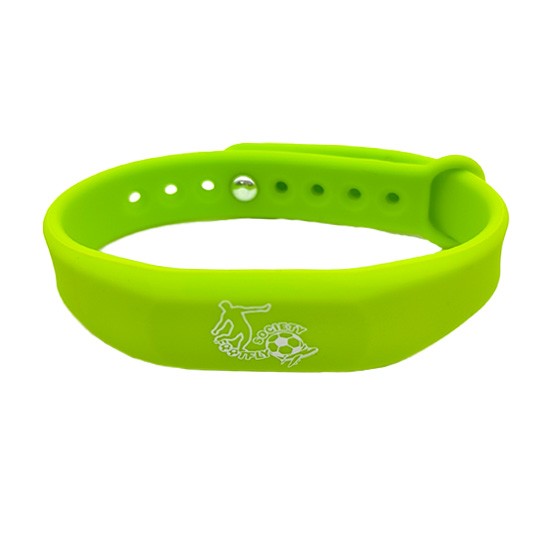
Una pulsera RFID de silicona es una pulsera reutilizable fabricada con caucho de silicona flexible que incorpora un chip RFID o NFC. El material es suave, ligero y cómodo, lo que la hace ideal para visitantes que necesiten llevar la pulsera durante varios días o usarla repetidamente.
La silicona también es altamente resistente al agua, al sudor y a las inclemencias del tiempo. Esto convierte a las pulseras RFID de silicona en una opción común para parques acuáticos, complejos turísticos, hoteles, gimnasios, programas de membresía y eventos de varios días.
Los fabricantes pueden personalizar las pulseras de silicona en diferentes colores y añadir logotipos, nombres, eslóganes y otros elementos de marca impresos o moldeados. Según el diseño, la pulsera puede llevar un botón a presión, una hebilla o un cierre ajustable.
La principal ventaja de la silicona es su larga vida útil. Un establecimiento puede recoger las pulseras después de su uso, desinfectarlas si es necesario y reutilizarlas para futuros visitantes. Esto convierte a la silicona en una opción práctica cuando se utilizan las mismas pulseras varias veces.
Sin embargo, una pulsera de silicona estándar generalmente se puede quitar y pasar a otra persona. Si se requiere un control estricto contra la transferencia, una pulsera desechable a prueba de manipulaciones podría ser más apropiada.
¿Qué es un? Pulsera RFID desechable?
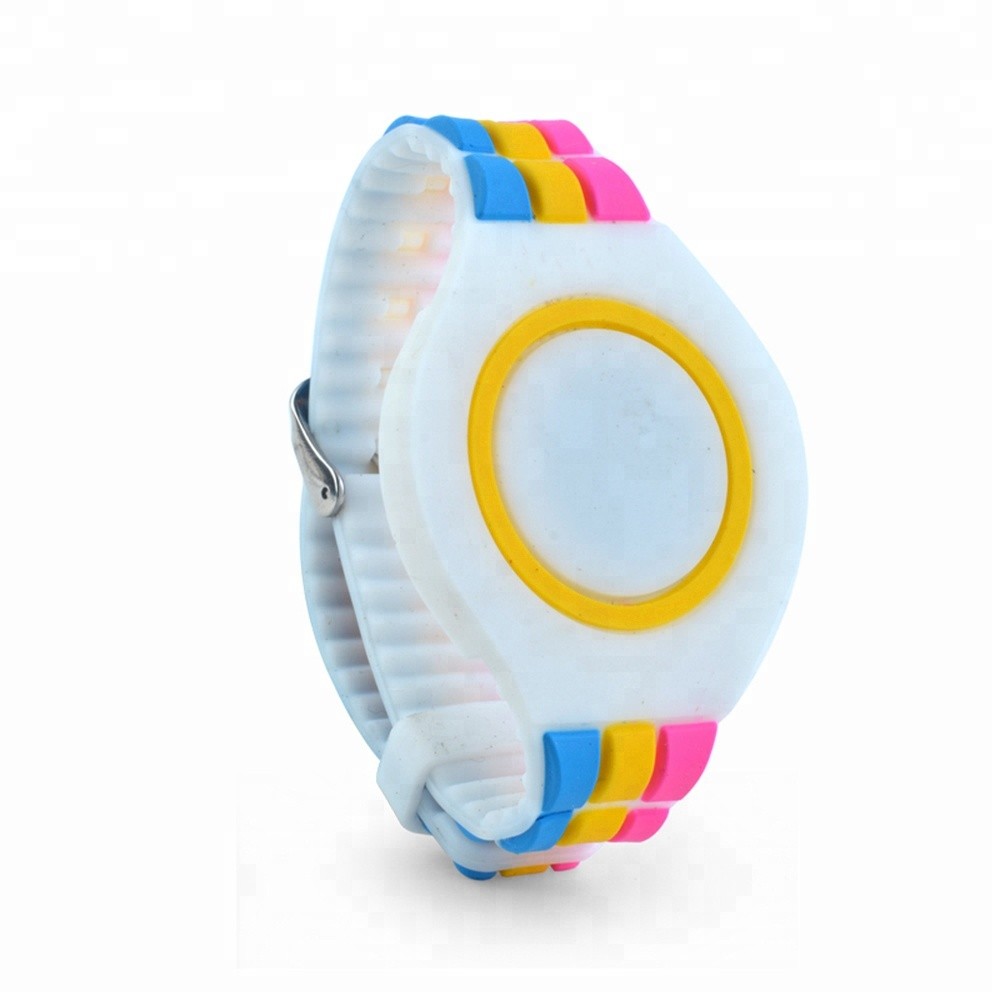
Una pulsera RFID desechable está diseñada para un solo evento, un solo período de acceso o un solo invitado. Los materiales más comunes son Tyvek, PVC y polipropileno (PP). Cada material tiene características diferentes.
Las pulseras Tyvek son ligeras y económicas, lo que las hace populares para conciertos, festivales, conferencias y otros eventos multitudinarios. Las pulseras de PVC son más duraderas y resistentes al agua, mientras que las de PP ofrecen un equilibrio entre flexibilidad y resistencia.
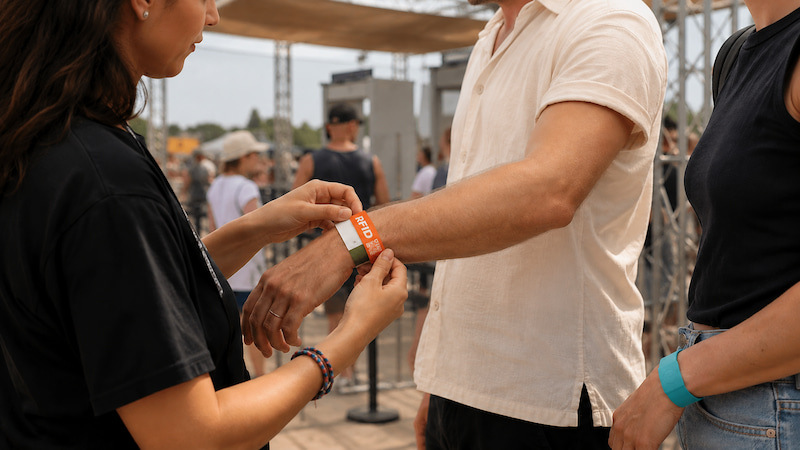
Las pulseras RFID desechables suelen incluir un cierre adhesivo de un solo uso, un broche de plástico u otro sistema a prueba de manipulaciones. Una vez retirada o abierta, la pulsera puede presentar daños visibles o resultar imposible volver a usarla. Esto ayuda a reducir el riesgo de que los visitantes transfieran sus credenciales de acceso a otra persona.
Las pulseras desechables también pueden imprimirse con logotipos del evento, códigos QR, códigos de barras, números de entrada, nombres y números de serie. Se puede utilizar la impresión variable y la codificación de chips cuando cada pulsera deba estar vinculada a una entrada, invitado o nivel de acceso específico.
Su principal limitación es que no están diseñados para un uso repetido. El Tyvek es especialmente adecuado para un uso a corto plazo, mientras que el PVC y el PP pueden ser mejores opciones cuando el evento dura varios días o implica contacto con agua.
Principales diferencias entre las pulseras RFID de silicona y las desechables
Reutilización y vida útil
Las pulseras RFID de silicona están diseñadas para un uso repetido. Esto las hace ideales para lugares con gran afluencia de público, como hoteles, complejos turísticos, parques acuáticos, gimnasios y clubes privados. Si bien su precio inicial puede ser mayor, su larga vida útil reduce la necesidad de reponerlas con frecuencia.
Las pulseras RFID desechables se usan normalmente una sola vez y luego se desechan. Son más prácticas para grandes eventos porque los organizadores no necesitan recogerlas, limpiarlas, inspeccionarlas ni redistribuirlas después del evento.
Seguridad a prueba de manipulaciones
Las pulseras desechables suelen ofrecer mayor protección contra la transferencia. Su cierre permite comprobar si la pulsera se ha retirado o cambiado. Esto resulta especialmente útil para eventos con entrada, zonas restringidas por edad, zonas VIP y sistemas de control de acceso multinivel.
Las pulseras de silicona permiten la identificación y el control de acceso, pero los diseños estándar suelen ser extraíbles. Son más adecuadas para entornos donde la reutilización y la comodidad son más importantes que una protección estricta contra la transferencia.
«A prueba de manipulaciones» significa que cualquier intento de abrir, quitar o modificar la pulsera deja evidencia visible. No significa que la pulsera sea imposible de dañar o burlar. El nivel de seguridad real depende del diseño del cierre y de la forma en que el personal verifica la pulsera.
Rendimiento impermeable
La silicona es ideal para ambientes húmedos. Una pulsera RFID de silicona bien sellada se puede usar al nadar, ducharse y realizar otras actividades acuáticas.
Las pulseras desechables varían considerablemente. El PVC y el PP suelen ser más adecuados para el agua y el uso en exteriores que el Tyvek. Si bien el Tyvek puede tolerar un contacto limitado con el agua, no debe considerarse automáticamente equivalente a una pulsera impermeable de silicona o PVC.
La construcción del chip y la incrustación también son importantes. Un material exterior impermeable no garantiza que todos los diseños de pulseras RFID tengan el mismo rendimiento. Se deben probar muestras en un entorno real antes de realizar un pedido grande.
Comodidad y tiempo de uso
La silicona es suave y flexible, por lo que suele ser más cómoda para usarla durante largos periodos. Es una buena opción cuando los invitados necesitan llevar la pulsera durante unas vacaciones, un periodo de membresía o un evento de varios días.
Las pulseras desechables suelen ser cómodas durante varias horas o un solo día. Los modelos de PVC y PP ofrecen mayor durabilidad para eventos prolongados, mientras que el Tyvek se suele elegir cuando la prioridad es el bajo coste y la ligereza.
Costo y valor total
Las pulseras RFID desechables suelen tener un precio unitario más bajo, especialmente para grandes cantidades. A menudo son la opción más económica para conciertos, festivales, exposiciones y eventos de un solo día.
Las pulseras de silicona suelen tener un precio unitario más elevado debido al material, el proceso de moldeo y su diseño reutilizable. Sin embargo, es importante considerar el precio inicial junto con la frecuencia de reutilización. Para un hotel o parque acuático, las pulseras de silicona reutilizables pueden ofrecer una mejor relación calidad-precio a largo plazo.
El precio final de cualquiera de los dos tipos también depende del chip RFID, la cantidad del pedido, la impresión, la codificación, los datos variables, el embalaje y el método de envío.
Personalización
Ambos tipos se pueden personalizar con logotipos, colores, texto y funciones RFID. Las pulseras de silicona admiten logotipos impresos o moldeados y suelen elegirse cuando la apariencia y la visibilidad de la marca a largo plazo son importantes.
Las pulseras desechables son especialmente adecuadas para información variable, como códigos QR únicos, códigos de barras, números de entrada, nombres de invitados y números de serie. También pueden suministrarse con datos RFID precodificados una vez confirmados el proceso de codificación y el sistema de lectura.
¿Qué pulsera RFID es la mejor para diferentes eventos?
Para un concierto o festival de un solo día, una pulsera RFID desechable de Tyvek o PVC suele ser la opción más práctica. Es económica, fácil de distribuir y puede ayudar a evitar la transferencia de entradas.
Para un festival de varios días, las pulseras desechables de PVC o PP pueden ser más adecuadas que las de Tyvek, ya que ofrecen mayor durabilidad y mejor resistencia a la humedad.
Para parques acuáticos, la silicona es una excelente opción cuando las pulseras se recogen y reutilizan. El PVC impermeable puede considerarse cuando la pulsera se usa solo en una visita o cuando se requiere seguridad a prueba de manipulaciones.
En hoteles y complejos turísticos, las pulseras RFID de silicona reutilizables suelen ser la opción preferida, ya que los huéspedes pueden usarlas durante toda su estancia y el establecimiento puede reutilizarlas después de recogerlas.
Para gimnasios, clubes y programas de membresía, la silicona suele ser más adecuada porque los miembros pueden usar la misma pulsera durante un período prolongado.
Para eventos VIP, las pulseras de silicona ofrecen una apariencia más exclusiva. En eventos multitudinarios con entrada, donde la rapidez, el coste y el control de acceso son factores clave, las pulseras desechables suelen ser más fáciles de gestionar.
Cómo elegir el chip RFID adecuado
El material de la pulsera es solo una parte de la solución. El chip RFID debe ser compatible con los lectores, el software y la función prevista para el evento.
Los chips MIFARE se utilizan habitualmente en sistemas de control de acceso, venta de entradas y gestión de eventos. El chip NTAG213 se suele elegir para interacciones NFC con smartphones, como abrir una página web o contenido digital. Para sistemas de control de acceso seguro, aplicaciones de pago o sistemas que requieran una mayor protección de datos, pueden ser necesarios chips más avanzados.
No se debe seleccionar un chip únicamente por su precio más bajo o mayor capacidad de memoria. Antes de la producción, es fundamental confirmar la frecuencia de funcionamiento, el estándar de comunicación, la compatibilidad con el lector, el formato de datos y los requisitos de codificación. Si la pulsera se utilizará para pagos sin efectivo, también se debe revisar el sistema de pago completo.
Recomendación final
Las pulseras RFID de silicona suelen ser la mejor opción cuando un evento requiere comodidad, durabilidad, resistencia al agua, uso repetido o una apariencia de alta calidad.
Las pulseras RFID desechables suelen ser la mejor opción cuando el evento es de corta duración, la asistencia es numerosa, el control del presupuesto es importante o se requiere un control de acceso a prueba de manipulaciones.
No existe una pulsera RFID ideal para todos los eventos. La elección correcta debe basarse en la duración del evento, el entorno de uso, los requisitos de seguridad, la cantidad prevista, el plan de reutilización y el sistema de lectura.
Preguntas frecuentes
¿Son reutilizables las pulseras RFID de silicona?
Sí. Las pulseras RFID de silicona están diseñadas normalmente para un uso repetido, siempre que la pulsera se mantenga en buen estado y el lugar cuente con un proceso adecuado de recogida y limpieza.
¿Son impermeables las pulseras RFID desechables?
Algunas sí lo son. Las pulseras de PVC y PP suelen ser más adecuadas para condiciones húmedas que las de Tyvek. Se recomienda probar su composición antes de usarlas en un parque acuático u otro entorno exigente.
¿Se pueden transferir las pulseras RFID a otra persona?
Las pulseras de silicona estándar pueden ser extraíbles y transferibles. Las pulseras desechables con cierres a prueba de manipulaciones están diseñadas para dificultar la transferencia y facilitar su detección por parte del personal.
¿Qué pulsera RFID es la más adecuada para un evento de un solo día?
Generalmente, una pulsera RFID desechable de Tyvek o PVC es adecuada. El Tyvek es económico y ligero, mientras que el PVC es una mejor opción cuando se necesita mayor durabilidad o resistencia al agua.
¿Pueden las pulseras RFID admitir pagos sin efectivo?
Sí, es posible, pero el chip, el lector, el software y el sistema de pago deben ser compatibles. Se recomienda verificar la compatibilidad del sistema completo antes de seleccionar la pulsera.
¿Pueden las pulseras RFID incluir códigos QR y números de serie?
Sí. Las pulseras RFID desechables y de silicona se pueden personalizar con códigos QR impresos, códigos de barras, números de serie y otra información variable. También es posible la precodificación si se proporciona el formato de datos requerido.


 Red IPv6 compatible
Chatea ahora
Escanear a WeChat :

Escanear a WhatsApp :

 CATEGORÍAS DE PRODUCTOS